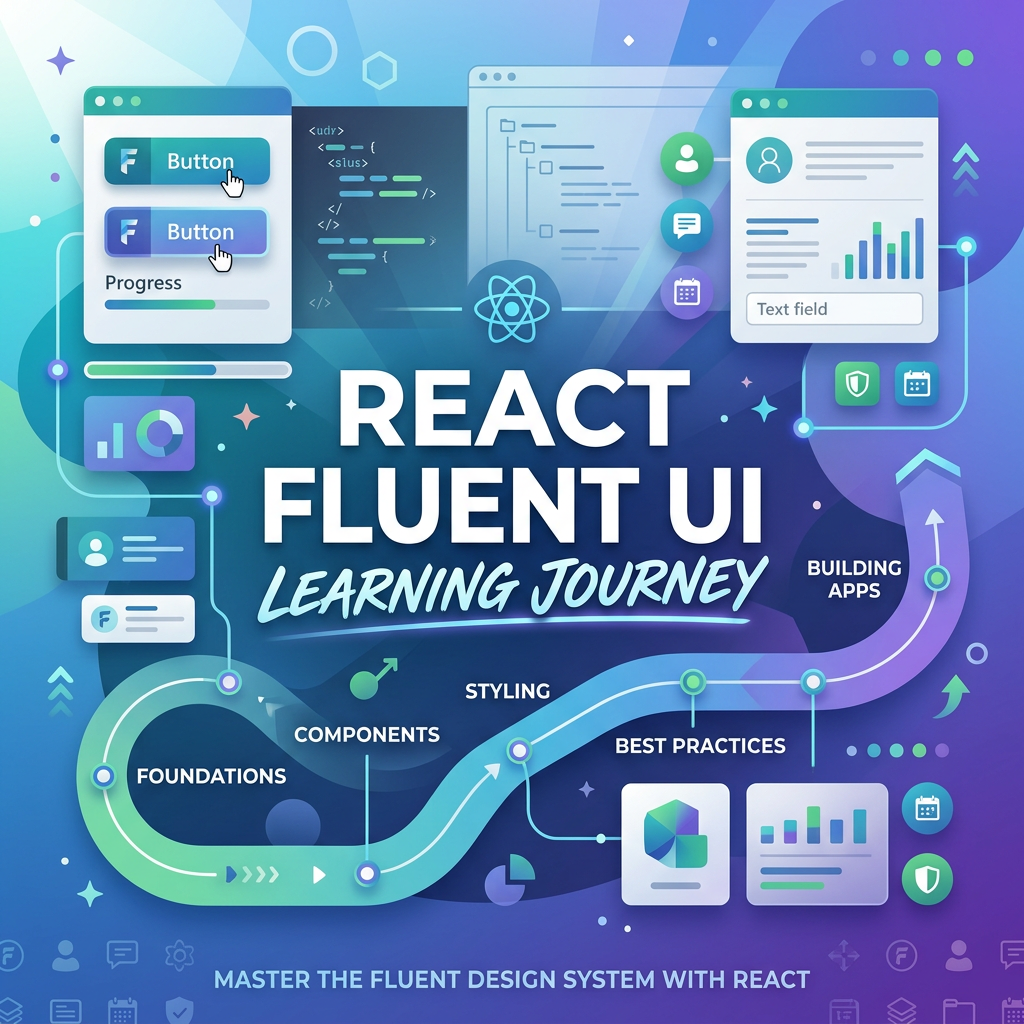
The Complete React + Fluent UI Learning Journey — 100 Enterprise Applications Explained
The 100 React + Fluent UI Apps Project was designed as a complete roadmap for mastering modern React architecture using:
- React
- TypeScript
- Vite
- Fluent UI
- Enterprise UI patterns
- Microsoft design standards
- Declarative rendering
- Component architecture
- State management
- Effects
- APIs
- Enterprise scalability
The entire roadmap is based on the official React learning model from React Learn and the Microsoft Fluent UI ecosystem from Fluent UI.
The progression is divided into five major blocks:
| Block | Focus |
|---|---|
| Block 1 | UI Fundamentals and Declarative Rendering |
| Block 2 | Interactivity and State |
| Block 3 | Professional Fluent UI Enterprise Patterns |
| Block 4 | Effects, APIs, and Architecture |
| Block 5 | Complete Enterprise Applications |
The structure of the project roadmap and architectural goals were defined in the uploaded project documents.
BLOCK 1 — UI FUNDAMENTALS AND DECLARATIVE RENDERING (01–20)
| App | Name | Technical Summary |
|---|---|---|
| 01 | Hello React Fluent | Introduces Vite, React, TypeScript, JSX, FluentProvider, and enterprise component rendering |
| 02 | Profile Card | Teaches props, component composition, Avatar usage, and reusable UI patterns |
| 03 | Product List | Introduces array rendering with map(), React keys, and declarative list rendering |
| 04 | Microsoft Style User Card | Builds reusable enterprise cards using Fluent UI design standards |
| 05 | Static Dashboard | Introduces dashboard layout composition, cards, metrics, and responsive UI |
| 06 | Corporate Sidebar Menu | Introduces enterprise layout architecture, sidebar composition, and navigation rendering |
| 07 | Visual Task List | Teaches pure components, reusable cards, badges, and component composition |
| 08 | Timeline of Events | Introduces sequential rendering and timeline-style enterprise layouts |
| 09 | Employee Table | Introduces structured tabular UI rendering and DataGrid concepts |
| 10 | Email List | Simulates Outlook-style layouts and enterprise messaging interfaces |
| 11 | Grid of Cards | Teaches CSS Grid composition and reusable dashboard patterns |
| 12 | Image Gallery | Introduces responsive image layouts and reusable media components |
| 13 | Movie Catalog | Teaches catalog rendering architecture and scalable card layouts |
| 14 | Football Teams List | Builds reusable entity cards and structured sports layouts |
| 15 | News Page | Introduces complex page composition and multi-section layouts |
| 16 | Financial Dashboard | Builds KPI dashboards using Fluent UI cards and metric composition |
| 17 | SharePoint Style Layout | Recreates enterprise Microsoft-style intranet layouts |
| 18 | File Explorer | Simulates Windows Explorer style UI and structured navigation layouts |
| 19 | Corporate Portal | Introduces enterprise portal architecture and content organization |
| 20 | Microsoft Style Landing Page | Builds institutional enterprise landing page composition |
BLOCK 2 — INTERACTIVITY AND STATE (21–40)
| App | Name | Technical Summary |
|---|---|---|
| 21 | Modern Counter | Introduces useState and event-driven UI updates |
| 22 | Toggle Theme | Teaches boolean state and dynamic UI rendering |
| 23 | React Calculator | Introduces derived state and event handling |
| 24 | Login Form | Teaches controlled inputs and form architecture |
| 25 | User Registration | Introduces validation and form state management |
| 26 | Complete ToDo List | Teaches CRUD-style array updates and dynamic rendering |
| 27 | Shopping List | Introduces list updates and state-driven rendering |
| 28 | Product Filter | Teaches derived state and filtering logic |
| 29 | Employee Search | Builds dynamic table filtering and search behavior |
| 30 | Shopping Cart | Introduces calculated totals and derived business state |
| 31 | Grade Simulator | Builds numeric calculations and interactive forms |
| 32 | Inventory Control | Introduces stock management state architecture |
| 33 | Contact Agenda | Teaches list CRUD operations and reusable forms |
| 34 | Currency Converter | Introduces numeric conversion state handling |
| 35 | BMI Calculator | Builds formula-driven UI and derived calculations |
| 36 | Installment Simulator | Teaches financial calculations and form interactions |
| 37 | Voting Panel | Introduces counters, votes, and aggregated state |
| 38 | Interactive Quiz | Builds question flow and conditional rendering |
| 39 | Team Manager | Teaches shared state and component coordination |
| 40 | Dynamic Dashboard | Introduces dynamic KPI updates and dashboard interactivity |
BLOCK 3 — PROFESSIONAL FLUENT UI ENTERPRISE PATTERNS (41–60)
| App | Name | Technical Summary |
|---|---|---|
| 41 | Microsoft Style Login | Builds enterprise authentication UI |
| 42 | Corporate Form | Introduces professional Fluent UI form composition |
| 43 | Tabs System | Teaches TabList architecture and section navigation |
| 44 | Dialog Manager | Introduces modals, overlays, and dialog workflows |
| 45 | Executive Dashboard | Builds executive KPI dashboards and analytics layouts |
| 46 | DataGrid Catalog | Introduces professional tabular rendering with DataGrid |
| 47 | Enterprise User List | Teaches Avatar, Badge, and user management layouts |
| 48 | Navigable Sidebar | Introduces scalable navigation architecture |
| 49 | Corporate Header | Builds enterprise toolbar and top navigation systems |
| 50 | Professional Toolbar | Teaches action-based toolbar composition |
| 51 | Notification System | Introduces alerts, badges, and notification UX |
| 52 | Administrative Panel | Builds admin-style enterprise architecture |
| 53 | Ticket Manager | Introduces enterprise workflow rendering |
| 54 | Approval System | Builds approval pipelines and business process UI |
| 55 | Corporate Agenda | Introduces scheduling and calendar-style layouts |
| 56 | SharePoint Inspired Dashboard | Simulates Microsoft 365 enterprise UI |
| 57 | Project Management | Builds enterprise project dashboard composition |
| 58 | Service Desk Control | Introduces support and ticket control systems |
| 59 | Visual CRM | Builds CRM-style customer management architecture |
| 60 | Corporate Explorer | Creates enterprise file-management-style interfaces |
BLOCK 4 — EFFECTS, APIS, AND ENTERPRISE ARCHITECTURE (61–80)
| App | Name | Technical Summary |
|---|---|---|
| 61 | REST API Consumption | Introduces useEffect, fetch, and async rendering |
| 62 | API Dashboard | Builds dashboards powered by remote APIs |
| 63 | Async Search | Introduces asynchronous querying and loading states |
| 64 | GitHub User Explorer | Consumes GitHub REST APIs and dynamic rendering |
| 65 | Weather App | Builds external API integration architecture |
| 66 | Pagination System | Introduces pagination logic and state coordination |
| 67 | Infinite Scroll | Builds scroll-based async rendering systems |
| 68 | Data Cache | Introduces memoization and client-side caching |
| 69 | Custom Fetch Hook | Teaches reusable custom hooks |
| 70 | Global Context Control | Introduces Context API architecture |
| 71 | Favorites System | Builds reusable global state architecture |
| 72 | API DataGrid | Combines APIs with enterprise DataGrid rendering |
| 73 | Analytical Dashboard | Builds analytical visualization architecture |
| 74 | Cryptocurrency Monitor | Introduces real-time data rendering concepts |
| 75 | Repository Explorer | Builds scalable API-driven search interfaces |
| 76 | Log Viewer | Introduces monitoring and structured log rendering |
| 77 | Reporting System | Builds enterprise report generation UI |
| 78 | Performance Simulator | Introduces optimization concepts and rendering analysis |
| 79 | Layered Architecture | Teaches enterprise folder and service architecture |
| 80 | Mini React Enterprise Framework | Consolidates reusable architecture patterns |
BLOCK 5 — COMPLETE ENTERPRISE APPLICATIONS (81–100)
| App | Name | Technical Summary |
|---|---|---|
| 81 | Complete CRUD System | Full enterprise CRUD architecture |
| 82 | Employee Management | Builds HR-style enterprise management systems |
| 83 | Financial Dashboard | Creates advanced analytical financial dashboards |
| 84 | Inventory System | Builds enterprise inventory architecture |
| 85 | Kanban Board | Introduces drag-and-drop workflow systems |
| 86 | Enterprise Task Manager | Builds scalable productivity architecture |
| 87 | User Management System | Introduces authentication-style UI flows |
| 88 | Administrative Portal | Builds multi-layout enterprise admin portals |
| 89 | Ticketing System | Creates help desk workflow management |
| 90 | Power BI Style Dashboard | Simulates enterprise BI dashboards |
| 91 | Report Generator | Builds dynamic reporting architecture |
| 92 | Audit System | Introduces audit log rendering and structured monitoring |
| 93 | SharePoint Inspired Portal | Builds Microsoft 365 intranet architecture |
| 94 | Corporate Catalog | Creates scalable enterprise catalog systems |
| 95 | Reservation System | Introduces scheduling workflows and business logic |
| 96 | Mini ERP Enterprise | Consolidates multiple business modules |
| 97 | Complete CRM | Builds enterprise customer relationship architecture |
| 98 | Analytics Platform | Creates analytical enterprise dashboards |
| 99 | Microsoft Style Admin Center | Simulates Microsoft enterprise admin UX |
| 100 | Final React Enterprise Platform | Final consolidated enterprise architecture project |
Technical Evolution Across the 100 Apps
| Area | Skills Learned |
|---|---|
| React Fundamentals | JSX, components, props, rendering |
| Layout Systems | Flexbox, Grid, responsive UI |
| Fluent UI | Enterprise Microsoft design system |
| State Management | useState, derived state, reducers |
| Events | Controlled forms and UI interactions |
| Architecture | Folder organization and scalability |
| APIs | Fetch, async rendering, REST consumption |
| Effects | Proper useEffect synchronization |
| Optimization | useMemo, useCallback, caching |
| Enterprise Patterns | Dashboards, portals, admin systems |
| Context API | Shared global state |
| Component Design | Reusable and composable architecture |
| TypeScript | Static typing and scalable contracts |
| Data Rendering | Lists, tables, DataGrid systems |
| UI Systems | Tabs, dialogs, sidebars, portals |
| Enterprise UX | Microsoft-style interfaces |
| Full Applications | CRUDs, ERP, CRM, Analytics |
Standard Project Structure Used Throughout the Journey
src/ components/ pages/ hooks/ services/ models/ data/ styles/ utils/
This structure was defined as the standard architecture for the React + Fluent UI roadmap.
Core React Mental Model Reinforced Across All Apps
The entire project reinforces the official React philosophy:
UI = function(data/state)
React applications are:
- declarative
- component-based
- predictable
- composable
- scalable
The roadmap intentionally evolves from:
- static rendering
- component composition
- interactivity
- state
- effects
- APIs
- enterprise architecture
This progression follows the official learning sequence recommended by React Learn.
Official Documentation
React
- React Learn
- Describing the UI
- Adding Interactivity
- Managing State
- Thinking in React
- Synchronizing with Effects
Fluent UI
Vite
TypeScript
Node.js
Current Project Status
| Block | Focus | Status |
|---|---|---|
| Block 1 | UI Fundamentals and Declarative Rendering | Completed |
| Block 2 | Interactivity and State | Next |
| Block 3 | Professional Fluent UI Architecture | Upcoming |
| Block 4 | Effects and Enterprise Architecture | Upcoming |
| Block 5 | Complete Enterprise Applications | Upcoming |


