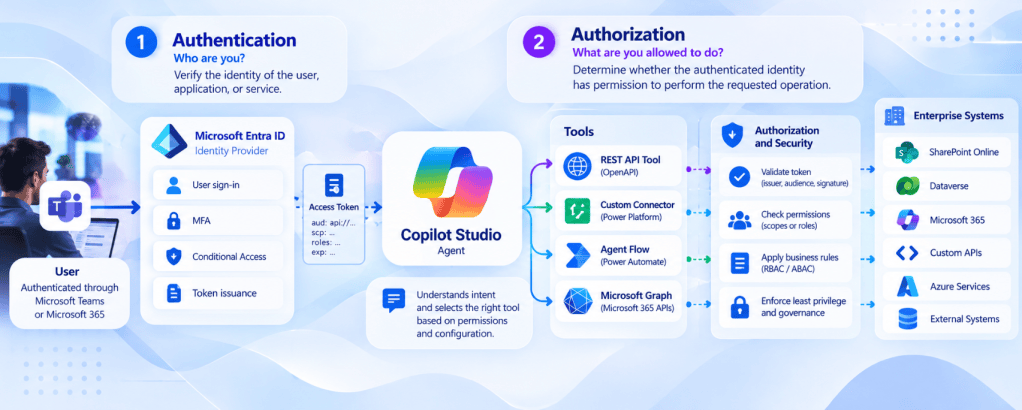
Article 22/50 — User-Provided vs Maker-Provided Credentials in Microsoft Copilot Studio
Enterprise AI Agents | Runtime Identity | Connection Security | SharePoint Online | Power Automate | Microsoft Entra ID | Governance
1. Introduction
One of the most consequential architectural decisions in Microsoft Copilot Studio is determining which credentials an Agent uses when executing a Tool.
An Agent can be configured to interact with authenticated users, retrieve enterprise information, invoke Power Platform Connectors, execute Agent Flows, and communicate with external business systems.
However, authenticating the person interacting with an Agent does not automatically establish which identity will execute every downstream operation.
This distinction becomes particularly important when the Agent accesses SharePoint Online, Dataverse, Microsoft Graph, or other protected enterprise resources.
Consider a simple request:
“Create a new access request in the SharePoint IT Support list.”
The Agent may correctly interpret the user’s intent, select a Tool, collect the necessary information, and execute the operation.
But an important security question remains:
Whose credentials were used to create the SharePoint item?
Was the operation executed using the employee’s own SharePoint permissions?
Or did it use a connection configured by the Agent maker?
The answer affects authorization, auditing, information disclosure, governance, and the overall security posture of the solution.
Microsoft Copilot Studio provides authentication options for supported Tools, including End user credentials and Maker-provided credentials.
These models serve different business requirements and introduce different security boundaries.
This article examines how they work, how to evaluate them, and how to design enterprise Agents that preserve appropriate authorization controls.
2. Understanding the Credential Problem
Traditional enterprise applications commonly separate user authentication from backend execution.
A user may authenticate to a web application through Microsoft Entra ID, while the application accesses its database through a separate service identity.
This is a legitimate architectural pattern when the application implements appropriate authorization controls.
AI Agents introduce a conversational interface into the same security model.
The user expresses an intention in natural language.
The Agent determines which Tool should execute.
The Tool accesses an external service.
That external service receives credentials associated with a particular identity.
The execution identity may differ from the conversational identity.
Identity Layers
| Layer | Responsibility | Example |
|---|---|---|
| Conversational User | Initiates request | Employee using Teams |
| Channel Authentication | Establishes user identity | Microsoft Entra ID |
| Copilot Studio Agent | Interprets request | IT Support Agent |
| Tool | Executes capability | Create SharePoint Item |
| Connection | Supplies authentication | User or maker connection |
| Resource | Enforces permissions | SharePoint Online |
| Audit System | Records execution | SharePoint / Power Platform logs |
The security of the overall solution depends on how these layers interact.
A valid user session does not automatically imply that the Tool uses that user’s credentials.
3. What Are User-Provided Credentials?
User-Provided Credentials, also referred to in Microsoft documentation and interfaces as End user credentials, allow a supported Tool to authenticate to an external service using the individual user’s connection.
For example, an employee interacts with an Agent that retrieves information from a SharePoint list.
If the SharePoint Connector Tool uses End user credentials, the employee must have a valid connection and sufficient SharePoint permissions for the requested operation.
The resource evaluates the permissions associated with that connection.
Conceptual Architecture
Employee → Copilot Studio Agent → SharePoint Connector → Employee Connection → SharePoint Online
The Agent orchestrates the operation.
The connection establishes the identity used by the connector.
SharePoint enforces the corresponding permissions.
Principal Characteristics
- Users authenticate to the relevant connected service.
- Each user can have an individual connection.
- Resource access follows the permissions associated with that connection.
- Users may need to establish or refresh connections.
- Unauthorized operations should be rejected by the resource.
- Connection availability depends on supported channels and integration mechanisms.
This model is generally appropriate when the business operation must respect individual user permissions.
4. What Are Maker-Provided Credentials?
Maker-Provided Credentials allow supported Tools to authenticate using a connection supplied by the Agent maker.
Instead of requiring each user to establish an individual connection, the Agent uses the configured connection when invoking the external service.
Conceptual Architecture
Employee → Copilot Studio Agent → SharePoint Connector → Maker Connection → SharePoint Online
The employee initiates the operation.
However, SharePoint evaluates the permissions associated with the maker-provided connection.
This creates a different security boundary.
The user may not possess direct access to the underlying SharePoint resource.
Nevertheless, the Tool may be able to perform an operation through the configured connection.
Whether this is acceptable depends on the business design and the authorization controls protecting the operation.
Typical Use Cases
- Shared information services.
- Low-risk operations.
- Controlled business request submission.
- Centralized service integrations.
- Operations where users should not require direct access to the backend resource.
Maker-provided credentials should not be interpreted as a general-purpose mechanism for bypassing user permissions.
5. Direct Comparison
| Dimension | End User Credentials | Maker-Provided Credentials |
|---|---|---|
| Authentication identity | Individual user connection | Maker-configured connection |
| Connection ownership | User-specific | Maker or configured connection owner |
| Resource permissions | User connection permissions | Maker connection permissions |
| Individual sign-in | May be required | Usually not required for the Tool connection |
| User-specific resource access | Naturally aligned | Requires additional controls if needed |
| Shared service access | Less convenient | Often more convenient |
| Administrative oversight | User connection lifecycle | Centralized connection risk |
| Permission concentration | Distributed | Potentially concentrated |
| Audit identity | User connection identity | Maker connection identity |
| User experience | Possible connection prompts | Often fewer prompts |
| Primary risk | Connection setup and consent | Privilege escalation or oversharing |
| Suitable scenario | User-specific data | Controlled shared capability |
Neither model is universally superior.
The correct choice depends on the business operation and the required security semantics.
6. Microsoft-Documented Behavior
Microsoft documents the two credential approaches for supported Copilot Studio Tools.
In the current Tool configuration experience, the maker can select the authentication model where the Tool supports that choice.
The documentation describes End user credentials as the model in which the user’s credentials authenticate with the connected service.
Maker-provided credentials use the author’s configured credentials.
Microsoft also documents administrative controls that can restrict the use of maker-provided credentials.
These controls are particularly important because shared connections can expose capabilities beyond an individual user’s permissions.
Important Scope Limitation
The availability and exact behavior of credential options depend on:
- Tool type.
- Connector capabilities.
- Agent authentication configuration.
- Channel support.
- Environment governance.
- Connection configuration.
- Current platform limitations.
Do not assume that every Copilot Studio Tool implements identical authentication behavior.
Official documentation:
7. Agent Authentication Is Not Tool Authentication
This is the most important conceptual distinction in the article.
An Agent may require users to authenticate with Microsoft Entra ID before starting a conversation.
This establishes the conversational user’s identity.
However, a Tool may independently require authentication to SharePoint Online, Dataverse, or an external API.
The Agent authentication configuration and Tool connection configuration solve different problems.
Example
An employee signs in to Microsoft Teams.
The employee opens a Copilot Studio Agent.
The Agent invokes a SharePoint Connector.
The SharePoint Connector uses a maker-provided connection.
The employee is authenticated, but the SharePoint operation uses the maker connection.
Authentication Boundary Matrix
| Boundary | Authentication Question |
|---|---|
| User → Teams | Who is the employee? |
| Teams → Agent | Is the Agent interaction authenticated? |
| Agent → Tool | Which Tool connection is configured? |
| Tool → SharePoint | Which identity authenticates to SharePoint? |
| SharePoint → Resource | Does that identity have permission? |
These questions must be answered separately.
8. Runtime Identity
Runtime identity refers to the identity effectively used when an operation executes.
An Agent interaction can involve multiple runtime identities.
For example:
User Identity → Agent Context → Tool Connection Identity → Backend Service Identity
The identities may be identical in some configurations.
They may also differ.
Runtime Identity Example
| Component | Identity |
|---|---|
| Microsoft Teams | Employee |
| Copilot Studio conversation | Authenticated employee |
| SharePoint Connector Tool | Maker connection |
| SharePoint Online | Maker connection account |
| SharePoint item Created By | Typically the executing SharePoint connection identity |
The final audit representation depends on the operation and underlying service.
The essential point is that the original conversational user and the resource execution identity are not necessarily the same.
9. Why Runtime Identity Matters
Runtime identity determines which permissions the downstream system evaluates.
Suppose an Agent accesses a restricted SharePoint library.
The employee does not have access to the library.
The maker does.
If the Tool uses maker-provided credentials, the Tool may retrieve information that the employee could not retrieve directly.
This creates an information disclosure risk.
Similarly, a maker connection may be able to update records, delete content, or change permissions beyond the employee’s own authority.
Therefore the architecture must consider both data retrieval and state-changing operations.
Risk Categories
| Risk | Description |
|---|---|
| Oversharing | User receives data accessible to maker |
| Privilege escalation | User indirectly invokes privileged capability |
| Unauthorized modification | Tool changes protected records |
| Audit ambiguity | Resource records maker rather than requester |
| Connection compromise | Shared identity exposes multiple operations |
| Operational dependency | Agent depends on maker connection lifecycle |
| Governance violation | Shared credential usage conflicts with policy |
These risks must be evaluated before production deployment.
10. SharePoint Online Scenario: Reading a Restricted List
Consider a SharePoint site:
The site contains a list named:
FinancialApprovals
Only Finance employees have permission to read its contents.
An Agent exposes a Tool called:
GetFinancialApprovalStatus
Scenario A: End User Credentials
The user authenticates through their SharePoint connection.
SharePoint evaluates that user’s permissions.
An unauthorized employee cannot retrieve protected records merely because the Agent exposes the Tool.
Scenario B: Maker-Provided Credentials
The Tool uses the maker’s SharePoint connection.
If the maker can read the list, the Tool may retrieve the requested records.
Without additional authorization controls, the Agent may expose protected information to users who lack direct SharePoint access.
Security Comparison
| Question | End User | Maker-Provided |
|---|---|---|
| Which account accesses SharePoint? | User | Maker connection |
| Must user have list access? | Yes, for direct connector access | Not necessarily |
| Can connection read restricted records? | Only if user permitted | If maker permitted |
| Is user-level authorization automatic? | Enforced for connection identity | Not automatically preserved |
| Recommended for confidential data | Often appropriate | Requires strong controls |
Architectural recommendation: Prefer user-context access for sensitive SharePoint information when the supported integration can preserve the intended permission boundary.
11. SharePoint Online Scenario: Creating a Request
Not every operation requires the user to have direct access to the underlying SharePoint list.
Consider an internal access-request system.
Employees must submit access requests, but they should not browse or modify other employees’ requests.
A maker-provided connection may be useful for creating records in a protected SharePoint list.
Proposed Architecture
Employee → Agent → CreateAccessRequest Tool → Controlled Connection → SharePoint Requests List
The Tool accepts only a narrow set of parameters:
- Target site.
- Requested role.
- Business justification.
The Tool creates a request record.
It does not grant SharePoint permissions.
Security Requirements
The solution should ensure that:
- Only authenticated users can submit requests.
- The requester identity is obtained through a trusted mechanism.
- Users cannot arbitrarily impersonate other employees.
- The Tool cannot perform unrelated SharePoint operations.
- Business validation is enforced.
- Request creation is audited.
Maker-provided credentials may be appropriate because the operation exposes a controlled business capability rather than unrestricted access to the underlying list.
12. The Confused Deputy Problem
The confused deputy problem occurs when a privileged component performs an unauthorized operation because a less-privileged caller influences its behavior.
Maker-provided credentials can introduce this risk.
Consider an Agent whose maker has SharePoint Site Owner permissions.
The Agent exposes a Tool capable of modifying permissions.
A regular employee asks:
“Grant me Owner access to the Finance site.”
If the Agent invokes the Tool without backend authorization, the maker connection may execute the operation.
The user has indirectly exercised privileges they do not possess.
Architectural Controls
- Restrict the operations exposed to the Agent.
- Avoid unnecessary Site Owner connections.
- Validate the authenticated requester.
- Enforce business authorization.
- Require approvals for privileged operations.
- Separate request submission from provisioning.
- Maintain audit records.
The Agent’s conversational Instructions are not a sufficient authorization boundary.
13. Tool Descriptions Do Not Enforce Security
Copilot Studio uses Tool descriptions to help Generative Orchestration select capabilities.
A Tool description might say:
“Use this Tool only when a Finance manager requests approval.”
This can influence Tool selection.
However, it does not verify that the caller is a Finance manager.
The backend must independently enforce that restriction.
Control Comparison
| Control | Guides Agent Behavior | Enforces Security |
|---|---|---|
| Tool description | Yes | No |
| Agent Instructions | Yes | No |
| Topic condition | Yes | Not as sole security boundary |
| User confirmation | Yes | No |
| Connector permissions | No | Yes, for connection identity |
| Backend authorization | No | Yes |
| SharePoint ACL | No | Yes |
| Business approval | No | Yes, when properly enforced |
The distinction between orchestration guidance and authorization enforcement is essential.
14. End User Credentials and SharePoint Permissions
End User Credentials are particularly useful when the intended business behavior is:
The Agent should access only what the user can access directly.
For example:
“Show my assigned training documents.”
If the Tool uses the user’s SharePoint connection, SharePoint can enforce the user’s permissions.
The Agent may interpret the request and present the results conversationally.
However, the resource remains responsible for deciding which content is accessible.
This approach aligns naturally with SharePoint’s existing permission model.
It is often preferable to implementing a separate authorization system inside the Agent.
15. Maker-Provided Credentials and Shared Services
Maker-provided credentials can be useful for operations where users should not directly access the underlying service.
Consider a corporate Agent that retrieves the current support team’s public telephone number.
The external service may require authentication, but the returned information is not confidential.
Requiring every employee to configure an individual connection may create unnecessary friction.
A shared connection can simplify the experience.
Suitable Characteristics
| Characteristic | Desired Property |
|---|---|
| Data sensitivity | Low |
| Operation scope | Narrow |
| Backend privileges | Minimal |
| User-specific authorization | Not required or enforced separately |
| Auditing | Available |
| Connection ownership | Controlled |
| Operational risk | Acceptable |
Maker-provided credentials are not inherently inappropriate.
The security concern arises when shared credentials expose broader capabilities than the business process requires.
16. Connection Ownership
A connection represents an authenticated relationship with an external service.
Connection ownership affects lifecycle management.
A connection may depend on:
- The associated account.
- Authentication tokens.
- Granted permissions.
- Tenant policies.
- Connection sharing.
- Credential renewal.
- Account status.
A production Agent should not depend casually on a personal maker account with broad administrative privileges.
If the maker leaves the organization or loses access, the integration may stop working.
Operational Risks
| Event | Possible Impact |
|---|---|
| Maker account disabled | Connection failure |
| Permissions removed | Authorization failure |
| Credential revoked | Authentication failure |
| Connection deleted | Tool failure |
| Environment migration | Connection remapping required |
| DLP policy changed | Integration blocked |
| Ownership transferred | Connection governance review required |
Connection ownership is an ALM and operational governance concern, not merely an authoring convenience.
17. Maker Account vs Service Account
A maker-provided connection may use the maker’s personal identity.
This is different from a deliberately managed service identity.
Personal Maker Account
A human account used during development.
Dedicated Service Account
An organizational account managed for a specific integration purpose.
Application Identity
A service principal or managed identity used by an appropriately designed application integration.
These are different identity models.
Comparison
| Identity | Typical Use | Main Concern |
|---|---|---|
| Personal maker | Development and testing | Ownership dependency |
| Dedicated service account | Shared connector execution | Credential and privilege management |
| Service principal | Application-to-application integration | Application permissions |
| Managed identity | Supported Azure workloads | Resource assignment and access |
| End user | User-specific operations | Individual permissions |
Do not assume that every Copilot Studio Tool can directly authenticate using every identity type.
The available methods depend on the integration mechanism.
18. User Connections and Consent
When a Tool requires End user credentials, users may need to establish a connection to the external service.
This can involve authentication and consent experiences, depending on the connector and identity provider.
The user should understand which service is being accessed and why.
For example, an Agent that retrieves the user’s SharePoint files may require an appropriate SharePoint connection.
The user may need to authenticate before the Tool can execute.
User Experience Considerations
- Connection prompts.
- Token expiration.
- Consent requirements.
- Connection renewal.
- Supported channels.
- Authentication failures.
- User guidance.
A secure configuration must also provide an understandable user experience.
Repeated connection failures can make an otherwise well-designed Agent unusable.
19. Single Sign-On Is Not Universal
Single Sign-On can reduce authentication friction.
However, an authenticated Microsoft Teams session does not automatically guarantee seamless authentication for every connector or external service.
The behavior depends on:
- Channel.
- Agent authentication mode.
- Connector.
- Identity provider.
- Supported SSO configuration.
- Tenant policies.
Microsoft documents limitations for certain connector authentication scenarios.
Therefore SSO behavior must be validated in the intended publication channel.
A successful test inside the Copilot Studio authoring environment does not guarantee identical behavior in Teams or another channel.
20. Authentication Support by Channel
Different Copilot Studio channels support different authentication capabilities.
For example, Microsoft documentation identifies supported and unsupported channels for user authentication with Tools.
The support matrix can change as the platform evolves.
Architectural Implication
A solution requiring individual user connections must verify channel compatibility before publication.
The architect should test:
- User sign-in.
- Connection creation.
- Token renewal.
- Tool execution.
- Permission enforcement.
- Error handling.
Do not design a security architecture around an assumed authentication capability that the target channel does not support.
Official reference:
21. Power Automate and Connection References
Power Automate introduces additional identity considerations.
A flow can use connector connections that are configured independently of the Agent’s conversational identity.
In solution-aware development, Connection References help associate flows with connections across environments.
However, a Connection Reference is not itself an authorization policy.
It identifies a connection dependency.
The actual connector action executes according to the configured connection and applicable flow runtime model.
Example
Agent → Agent Flow → SharePoint Create Item
The SharePoint action may use a connection associated with a configured account.
The Agent’s user identity is not automatically the SharePoint execution identity.
Important Questions
| Question | Architectural Concern |
|---|---|
| Who owns the flow? | Operational ownership |
| Which connection executes the action? | Runtime identity |
| Is the connection shared? | Privilege concentration |
| Can users supply arbitrary parameters? | Input security |
| Does the flow enforce business rules? | Authorization |
| How is the requester recorded? | Auditability |
22. Agent Flows and Credential Boundaries
Agent Flows allow Copilot Studio Agents to execute deterministic business processes.
However, the flow’s internal connector actions may introduce additional connection boundaries.
For example:
Agent → Flow → SharePoint → Outlook
The SharePoint and Outlook actions may use different connections.
Therefore the flow should not be treated as having one universal execution identity for every downstream service.
Flow Identity Matrix
| Component | Identity to Verify |
|---|---|
| Agent user | Conversational identity |
| Flow invocation | Supported Tool authentication context |
| SharePoint action | SharePoint connection |
| Outlook action | Outlook connection |
| Custom API action | API authentication configuration |
| Business record | Actual resource execution identity |
The effective identities must be verified in the deployed environment.
23. Example: SharePoint Training Request Agent
Consider a training request Agent.
Employees can ask:
“Register me for the Power Platform security workshop.”
The Agent invokes an Agent Flow.
The flow creates an item in a SharePoint list.
Proposed Data Contract
{ "trainingId": "PP-SEC-101", "requestReason": "Required for my current project", "correlationId": "illustrative-correlation-id"}
The requester identity should be derived from trusted authenticated context, not accepted blindly as a user-editable input.
Example Result
{ "success": true, "requestId": 1055, "status": "Submitted"}
The Agent should respond:
“Your training request 1055 was submitted successfully.”
It should not claim that the employee is already enrolled unless the backend confirms enrollment.
24. Identity Spoofing Through Tool Parameters
A common mistake is accepting an email address from the conversation and treating it as verified identity.
For example:
{ "requestedBy": "finance.director@contoso.com", "action": "ApproveAccess"}
If the Agent allows the user to supply this value, an attacker may impersonate another employee.
The backend should not authorize sensitive operations based solely on such a field.
Safer Approach
Use an authenticated identity established through a supported mechanism.
For a custom API, validate the access token and derive identity from trusted claims.
For a connector-based integration, understand which authenticated connection identity is available.
If the business operation requires the original conversational user’s identity, design a trustworthy way to establish and propagate it.
25. Authentication vs Authorization in Shared Connections
Maker-provided credentials solve the authentication problem for the connected service.
They do not automatically solve user-specific authorization.
Consider:
User A → Agent → Shared Connection → SharePoint
The shared connection may have permission to read a list.
However, User A may only be authorized to view their own records.
SharePoint evaluates the shared connection’s permissions, not User A’s permissions, unless the integration implements an additional supported authorization mechanism.
The business service must therefore enforce the intended user-level restriction.
Security Layers
| Layer | Question |
|---|---|
| Agent authentication | Who is User A? |
| Tool authentication | Which connection is used? |
| Resource authorization | What can that connection access? |
| Business authorization | Which records may User A access? |
| Audit | Who initiated the request? |
The fourth layer is especially important when using shared connections.
26. Resource-Level Authorization
Enterprise authorization frequently depends on the specific resource.
For example, a manager may approve requests for one department but not another.
A user may have access to one SharePoint site but not another.
A service account may have access to multiple sites.
Therefore authorization should consider both the caller and the target resource.
Example Policy
A request may be approved only when:
- The caller is authenticated.
- The caller has an appropriate role.
- The request belongs to an authorized department.
- The request is in Pending status.
- The caller is not prohibited from approving their own request.
These rules should be enforced by the backend.
They should not depend solely on the Agent’s interpretation.
27. Least Privilege for Maker Connections
If maker-provided credentials are necessary, the connection should have minimal permissions.
Consider a Tool that creates SharePoint access requests.
The connection should not require tenant administrator permissions.
It should only have access to the specific resource and operation needed.
Permission Design
| Requirement | Recommended Principle |
|---|---|
| Create request item | Grant narrowly scoped write access |
| Read request status | Grant required read access |
| Approve request | Separate authorized operation |
| Modify site permissions | Dedicated privileged service |
| Delete records | Exclude unless required |
| Read unrelated sites | Do not grant |
The objective is to reduce the impact of incorrect Tool selection, malicious input, or connection compromise.
28. Least Capability
Least capability complements least privilege.
An Agent should expose only the Tools necessary for its business purpose.
For example, an access-request Agent may need:
CreateAccessRequest
GetAccessRequestStatus
It probably does not need:
DeleteSharePointSite
GrantSiteCollectionAdministrator
ExportAllEmployeeRecords
Even if the maker connection possesses broader permissions, limiting exposed Tools reduces the Agent’s attack surface.
However, Tool restrictions do not replace backend authorization.
Both controls should be applied.
29. User Confirmation Before Tool Execution
Copilot Studio supports configuration options for asking users to confirm Tool execution in supported experiences.
Confirmation can improve transparency before executing consequential operations.
For example:
“You are about to submit an access request for the Finance site. Continue?”
This may reduce accidental execution.
However, confirmation is not authorization.
A user confirming an unauthorized operation does not make it permissible.
Confirmation vs Authorization
| Mechanism | Purpose |
|---|---|
| Confirmation | Verify user intention |
| Authentication | Establish identity |
| Authorization | Enforce permissions |
| Business validation | Enforce process rules |
| Audit | Record execution |
All may be relevant to sensitive enterprise operations.
30. Microsoft Entra ID and Custom APIs
A custom REST API may use Microsoft Entra ID for authentication.
This provides an opportunity to implement explicit backend authorization.
For example:
Agent → Custom Connector → Protected API → SharePoint Integration Service
The API validates an access token.
It then checks the caller’s permissions before performing the operation.
Important Distinction
The token may represent a user or an application, depending on the supported authentication flow.
A maker-provided connection does not automatically provide a delegated token for the conversational user.
If user-specific authorization is required, the architecture must explicitly establish trusted caller context.
31. Delegated Permissions vs Application Permissions
Delegated permissions allow an application to access resources in the context of a signed-in user.
Application permissions allow an application to operate using its own identity.
Comparison
| Dimension | Delegated | Application |
|---|---|---|
| User context | Present | Not inherent |
| Typical token claim | scp | roles |
| Common use | User-driven operations | Background processing |
| User resource permissions | Relevant | Not automatically inherited |
| Security concern | Excessive scopes | Overprivileged application |
| Agent relevance | User-specific access | Controlled backend services |
These Microsoft Entra permission models are related to, but not identical to, Copilot Studio’s End user and Maker-provided credential options.
Do not treat the two pairs of concepts as interchangeable.
A Tool connection model describes how credentials are supplied.
Delegated and application permissions describe authorization models for supported APIs.
32. Why Maker-Provided Does Not Mean Application Permissions
This distinction deserves particular attention.
A maker-provided connection may authenticate using the maker’s personal account.
That is not the same as using application permissions.
For example:
A maker configures a SharePoint Connector using their own Microsoft 365 account.
The Tool executes using that connection.
This does not automatically make the operation application-only.
The connection may still represent a human user identity.
Conceptual Comparison
| Concept | Meaning |
|---|---|
| Maker-provided credentials | Connection supplied by Agent maker |
| End user credentials | Connection supplied by Agent user |
| Delegated permissions | API access in signed-in user context |
| Application permissions | API access using application identity |
| Service account | Managed organizational account |
| Managed identity | Identity assigned to supported Azure resource |
These concepts operate at different architectural layers.
33. Managed Identity as an Alternative
For custom Azure-hosted services, managed identities can reduce dependency on stored application secrets.
Consider:
Copilot Studio → Protected API → Azure Function → Managed Identity → Enterprise Resource
The Azure Function uses its managed identity to access supported downstream resources.
This can be appropriate for controlled backend operations.
However, the API must still authorize the original request.
A managed identity provides authentication for the Azure workload.
It does not automatically prove that the conversational user is permitted to perform the requested business operation.
34. Connection Sharing
Power Platform connections can have sharing capabilities depending on connector and connection type.
Sharing a connection may allow other authorized users or components to use the configured connection.
This must be treated as a security-sensitive operation.
Review Questions
- Who owns the connection?
- Who can use it?
- Who can share it further?
- Which permissions does it possess?
- Which Agents depend on it?
- What happens when it is revoked?
- How is its use audited?
A shared connection should have an explicit owner and operational purpose.
Avoid uncontrolled sharing of highly privileged connections.
35. Environment-Level Governance
Microsoft provides administrative controls for maker-provided credentials in Copilot Studio.
Administrators can configure which credential options are available to makers in supported environments or environment groups.
This allows organizations to restrict or prevent maker-provided credentials.
Governance Options
| Policy Approach | Architectural Effect |
|---|---|
| Allow End user credentials | Supports individual connections |
| Allow Maker-provided credentials | Supports shared connection model |
| Allow both | Makers can select appropriate model |
| Restrict maker credentials | Reduces shared-identity exposure |
| Apply environment governance | Standardizes controls across Agents |
Microsoft documentation states that both credential options are enabled by default in the documented governance experience.
Organizations should review the actual configuration rather than assuming the environment follows a preferred security baseline.
Official reference:
36. Impact of Disabling Maker-Provided Credentials
Restricting maker-provided credentials is not merely a change to the authoring interface.
Microsoft documents that this governance control can affect existing Agents and their Tool authentication behavior.
Agents may require End user authentication for Tool execution.
This can introduce connection prompts and affect previously functioning integrations.
Operational Considerations
| Area | Potential Impact |
|---|---|
| Existing Agents | Credential model may change |
| Tool execution | User connection may be required |
| User experience | Additional sign-in prompts |
| Shared services | Existing execution model disrupted |
| Testing | Regression testing required |
| Publishing | Configuration review may be necessary |
| Autonomous execution | Background execution may fail |
Administrators should evaluate existing dependencies before changing credential policies.
37. Autonomous Agents and Credentials
Autonomous Agents may execute in response to scheduled or event-driven triggers rather than direct user interaction.
This creates a special authentication challenge.
If a Tool requires a live user’s connection or interactive authentication, the operation may not be executable in an unattended context.
Microsoft explicitly documents this concern in the governance guidance for maker-provided credentials.
Architectural Implication
Unattended execution requires an authentication model that supports unattended operation.
A design that works during an interactive Teams conversation may not work when executed by an autonomous trigger.
The authentication strategy must be considered before selecting the execution model.
38. Security Scanning
Copilot Studio includes an automatic security scan that can identify certain risky Agent configurations before publication.
Microsoft documents warnings associated with configurations such as:
- Anonymous Agent access.
- Maker-provided credentials for supported Tools.
- Broad Agent sharing.
These warnings help makers recognize potential exposure.
However, automated scanning cannot replace a complete architectural security review.
A Tool may pass configuration checks while still exposing excessive business capabilities through an overprivileged backend.
Security Review Layers
| Layer | Control |
|---|---|
| Platform configuration | Security scan |
| Environment governance | Admin policies |
| Tool configuration | Credential selection |
| Connection | Permission review |
| Backend | Authorization enforcement |
| Business process | Approval and validation |
| Operations | Audit and monitoring |
Security requires defense in depth.
39. DLP and Credential Governance
Power Platform Data Loss Prevention policies govern supported connectors and data movement capabilities.
Credential governance determines which authentication models are permitted.
These controls address different risks.
Comparison
| Control | Primary Purpose |
|---|---|
| DLP | Restrict data movement and connector use |
| Credential policy | Restrict Tool authentication models |
| Environment security | Control maker and resource access |
| Backend authorization | Enforce business permissions |
| Least privilege | Limit connection permissions |
| Audit | Record execution |
An allowed connector may still use an overprivileged connection.
Similarly, a correctly scoped connection may be blocked by DLP policy.
Both dimensions must be reviewed.
40. ALM and Connection References
Enterprise Agents should be deployed through controlled environments.
A typical architecture includes:
DEV → TEST → PROD
Connections should be managed appropriately for each environment.
A development maker’s personal connection should not automatically become the production execution identity.
ALM Considerations
| Artifact | Deployment Consideration |
|---|---|
| Agent | Solution lifecycle |
| Tool | Connection and configuration |
| Agent Flow | Flow dependencies |
| Connection Reference | Environment-specific connection mapping |
| Custom Connector | API endpoint and authentication |
| Environment Variable | Environment-specific values |
| Service Account | Ownership and permissions |
| Backend API | Deployment and versioning |
| DLP Policy | Environment governance |
Connection references support deployment management.
They do not eliminate the need to validate the permissions of the actual connections assigned in each environment.
41. Production Connection Ownership
Production connections should have documented operational ownership.
Important questions include:
- Who maintains the connection?
- Who approves permission changes?
- Who monitors authentication failures?
- What happens if the account is disabled?
- How are credentials renewed?
- How is access revoked?
- Who investigates security incidents?
A production Agent that depends on an undocumented personal account creates avoidable operational risk.
A dedicated connection strategy should be part of the solution architecture.
42. Auditing and Identity Attribution
A resource system often records the identity associated with the connection executing an operation.
For example, a SharePoint list item created through a shared connection may record the shared account as the creator.
This does not necessarily identify the employee who initiated the Agent conversation.
Therefore enterprise audit records may need to distinguish:
- Conversational requester.
- Tool execution identity.
- Backend service identity.
- Approver.
- Target resource.
- Operation.
- Result.
- Timestamp.
- Correlation identifier.
Illustrative Audit Record
{ "requestId": 1055, "initiatedBy": "authenticated-user-reference", "executedBy": "sharepoint-service-connection", "operation": "CreateAccessRequest", "targetResource": "Finance", "status": "Submitted", "correlationId": "transaction-reference"}
The requester identity must come from a trustworthy source.
A user-editable text field is not sufficient evidence for security-sensitive attribution.
43. Troubleshooting Credential Problems
Authentication and authorization failures should be investigated systematically.
Diagnostic Matrix
| Symptom | Possible Cause | Investigation |
|---|---|---|
| User prompted to connect | End user credentials configured | Tool authentication |
| Tool works for maker only | User lacks connection or permissions | User connection |
| Tool accesses unexpected data | Maker connection has broad access | Runtime identity |
| SharePoint item shows maker | Shared connection executed action | Connector identity |
| Tool returns 401 | Invalid or expired authentication | Connection/token |
| Tool returns 403 | Insufficient resource permissions | Authorization |
| Agent works in test but fails in Teams | Channel authentication difference | SSO/channel |
| Flow fails after deployment | Connection reference mismatch | ALM configuration |
| Autonomous trigger fails | Interactive authentication required | Credential policy |
| Tool stops after admin policy change | Maker credentials restricted | Environment governance |
The recommended troubleshooting approach is to verify one identity boundary at a time.
Start with the Agent authentication configuration.
Then inspect Tool credentials.
Then inspect the actual connector connection.
Finally, verify downstream resource permissions.
44. Security Test Matrix
Testing must include different user identities.
Testing only with the Agent maker is insufficient because the maker may have broader permissions than ordinary users.
Recommended Test Accounts
- Agent maker.
- Ordinary employee.
- Employee with restricted SharePoint access.
- Authorized manager.
- Unauthorized employee.
- Connection owner.
Test Scenarios
| Test | Expected Result |
|---|---|
| Authorized user with End user connection | Operation succeeds |
| Unauthorized user with End user connection | Resource denies operation |
| User without configured connection | Authentication or connection flow |
| Maker connection with broad permissions | Additional business controls required |
| User attempts impersonation | Backend rejects unauthorized identity |
| User requests privileged operation | Authorization enforced |
| Connection revoked | Controlled authentication failure |
| Maker account disabled | Dependency detected |
| Environment credential policy changed | Configuration and regression review |
| Autonomous trigger without valid credentials | Execution failure handled |
Security testing should verify actual downstream behavior, not merely the Agent’s conversational response.
45. Architecture Decision Matrix
| Business Scenario | Preferred Starting Model | Reason |
|---|---|---|
| Retrieve user’s SharePoint documents | End user credentials | Preserve individual permissions |
| Read confidential user-specific data | End user credentials | Resource-level access |
| Retrieve shared low-risk information | Maker-provided may be appropriate | Simplified access |
| Create internal request record | Controlled shared connection may be appropriate | Users need not access backend list |
| Modify protected SharePoint permissions | Privileged backend service | Strong authorization |
| Read personal Microsoft 365 data | Delegated user-context integration | User-specific authorization |
| Execute scheduled process | Supported unattended identity | No interactive user |
| Integrate reusable enterprise API | Custom Connector / API | Reuse and governance |
| Execute complex business transaction | Backend API or Agent Flow | Deterministic validation |
| Operate across several departments | Explicit business authorization | Prevent cross-department access |
These are architectural recommendations.
The exact implementation depends on supported connector authentication methods and organizational requirements.
46. When Not to Use Maker-Provided Credentials
Maker-provided credentials are generally a poor default when:
- The Tool accesses confidential user-specific information.
- The maker has significantly broader permissions than Agent users.
- The Tool exposes destructive operations.
- The backend lacks user-level authorization.
- The connection uses an administrative account unnecessarily.
- The original requester cannot be reliably identified.
- The organization prohibits shared credentials.
- The operation requires strict per-user audit attribution.
In these situations, prefer user-context access or a carefully designed backend service that enforces authorization independently.
47. When Maker-Provided Credentials May Be Appropriate
Maker-provided credentials may be suitable when:
- The operation is low risk.
- The data is intended for the Agent’s entire authorized audience.
- The backend capability is narrowly scoped.
- Users should not require direct access to the underlying system.
- The connection has minimal permissions.
- Business authorization is enforced where necessary.
- Operational ownership is documented.
- The environment permits the credential model.
For example, creating a request in a protected SharePoint list can be a reasonable use case when the Tool exposes only a controlled request-submission capability.
48. Enterprise Reference Architecture
A mature enterprise design separates user identity, Tool connection identity, and backend authorization.
User-Specific Access
Authenticated User → Copilot Studio → End User Connection → SharePoint Online → Authorized Result
Controlled Shared Capability
Authenticated User → Copilot Studio → Maker-Provided Connection → Restricted Business Service → Authorization and Validation → SharePoint Online
Privileged Backend Operation
Authenticated User → Copilot Studio → Request Submission → Approval → Privileged Provisioning Service → SharePoint Online
These patterns serve different requirements.
They should not be treated as interchangeable.
The architectural decision should be based on the required trust boundary.
49. Enterprise Credential Design Checklist
| Area | Review Question |
|---|---|
| Agent authentication | Is the conversational user authenticated? |
| Tool authentication | Which credential model is configured? |
| Connection owner | Who owns the connection? |
| Runtime identity | Which identity executes downstream operations? |
| SharePoint permissions | What can that identity access? |
| Business authorization | Are user-specific restrictions enforced? |
| Least privilege | Are connection permissions minimized? |
| Least capability | Are unnecessary Tools excluded? |
| Sensitive operations | Are approvals or confirmations required? |
| Audit | Is the original requester traceable? |
| Credential lifecycle | Can credentials be revoked and renewed? |
| Environment governance | Are maker credentials permitted? |
| DLP | Are connectors allowed? |
| Channel support | Does authentication work in the target channel? |
| Autonomous execution | Is unattended authentication supported? |
| ALM | Are production connections independently managed? |
| Testing | Have multiple user identities been tested? |
| Monitoring | Are failures and suspicious operations observable? |
50. Conclusion
User-Provided and Maker-Provided Credentials represent different approaches to authenticating Copilot Studio Tools.
End user credentials are generally appropriate when operations must respect individual users’ permissions.
Maker-provided credentials can simplify access to shared services and controlled business capabilities, but they introduce an additional trust boundary.
The identity used by a Tool may possess permissions different from those of the person interacting with the Agent.
This difference affects confidentiality, authorization, auditing, operational ownership, and governance.
A secure enterprise architecture must therefore distinguish:
Conversational Identity
Tool Connection Identity
Backend Execution Identity
Resource Authorization
Business Authorization
These responsibilities should be documented and tested independently.
The most important architectural principle is:
An authenticated Agent user does not automatically imply user-authorized Tool execution. The effective security boundary is determined by the credentials, permissions, and authorization controls used throughout the complete execution chain.
For enterprise implementations, credential selection should be a deliberate architectural decision rather than a convenient configuration default.
51. Learning Journey — Where We Are and What’s Next
This article belongs to a structured 50-article series exploring Microsoft Copilot Studio, enterprise AI Agents, SharePoint Online, Microsoft 365, integration architecture, security, governance, and production deployment.
Current Progress
| Milestone | Articles | Topic | Status |
|---|---|---|---|
| Foundations | 01–13 | AI Agents, Knowledge, Retrieval, Grounding, RAG, Topics, and Actions | Completed |
| Integration Architecture | 14–20 | Tools, Agent Flows, Power Automate, SharePoint, REST APIs, and OpenAPI | Completed |
| Identity Foundations | 21 | Authentication vs Authorization | Article Produced |
| Current Article | 22/50 | User-Provided vs Maker-Provided Credentials | Under Editorial Review |
| Next Article | 23/50 | Least Privilege and Runtime Identity in Copilot Studio | Up Next |
| Security Governance | 24 | DLP and Governance for Enterprise AI Agents | Upcoming |
| Advanced Agent Architecture | 25–40 | Triggers, Autonomous Agents, Multi-Agent Systems, Connectors, and MCP | Upcoming |
| Enterprise Implementation | 41–50 | SharePoint Security, Testing, Monitoring, Publishing, ALM, and Reference Architecture | Upcoming |
Current progress: 22 of 50 articles drafted — 44% of the planned series.
What’s Next — Article 23/50
Least Privilege and Runtime Identity in Microsoft Copilot Studio
The next article will expand the security architecture beyond credential selection.
It will examine how to design restricted execution identities, minimize Tool permissions, isolate privileged operations, implement authorization boundaries, and validate runtime access across SharePoint Online, Power Automate, Custom Connectors, and enterprise APIs.
The next architectural question: How can an enterprise Agent execute useful business operations without receiving unnecessary privileges or exposing unauthorized capabilities?
52. Official Microsoft Documentation
1. Configure user authentication for tools
Explains authentication options, user connections, permission management, and supported channels.
2. Use connectors in Copilot Studio agents
Documents connector Tools and maker-provided credential configuration.
3. Add tools to custom agents
Explains Tool configuration, authentication options, orchestration, and execution behavior.
4. Control maker-provided credentials for authentication
Documents administrative restrictions on maker-provided credentials and the implications for existing and autonomous Agents.
5. Automatic security scan in Copilot Studio
Describes security warnings associated with risky Agent configurations.
6. Configure data policies for agents
Explains DLP and governance controls for Copilot Studio.
7. Plan and design integration strategies
Discusses architectural choices involving connectors, HTTP requests, and Agent Flows.
8. Configure user authentication
Explains Agent authentication configuration.
9. Microsoft Graph permissions overview
Explains delegated and application permissions.
10. Microsoft identity platform
Provides Microsoft Entra ID authentication and authorization documentation.
11. OAuth 2.0 On-Behalf-Of flow
Documents delegated token exchange for supported middle-tier architectures.
12. SharePoint permission levels
Explains SharePoint permission levels and authorization concepts.
53. Final Technical Summary
| Concept | Definition | Enterprise Relevance |
|---|---|---|
| End User Credentials | User-specific Tool connection | Preserve individual access |
| Maker-Provided Credentials | Maker-configured Tool connection | Shared service execution |
| Agent Authentication | Authentication of conversational user | Establish user identity |
| Tool Authentication | Authentication to external service | Execute Tool |
| Runtime Identity | Effective execution identity | Determine permissions |
| Connection Ownership | Account controlling connection | Operational governance |
| SharePoint Permissions | Resource-level authorization | Protect enterprise data |
| Delegated Permissions | API access in user context | User-specific operations |
| Application Permissions | API access as application | Background services |
| Service Account | Managed organizational account | Shared integrations |
| Managed Identity | Azure-managed workload identity | Azure service authentication |
| Least Privilege | Minimum required permissions | Reduce exposure |
| Least Capability | Minimum required Tools | Reduce attack surface |
| Backend Authorization | Deterministic permission enforcement | Protect operations |
| Confused Deputy | Misuse of privileged component | Security threat |
| DLP | Connector and data governance | Organizational control |
| Connection Reference | Solution connection dependency | ALM |
| Security Scan | Platform configuration checks | Risk awareness |
| Autonomous Execution | Unattended Agent operation | Credential planning |
| Auditability | Trace execution and requester | Accountability |
Final Architecture
User → Authenticated Agent → Tool → Configured Connection Identity → Backend Authorization → Enterprise Resource → Audited Result
The identity that initiates the conversation and the identity that executes the business operation may be different. Secure Agent architecture must explicitly control that difference.


